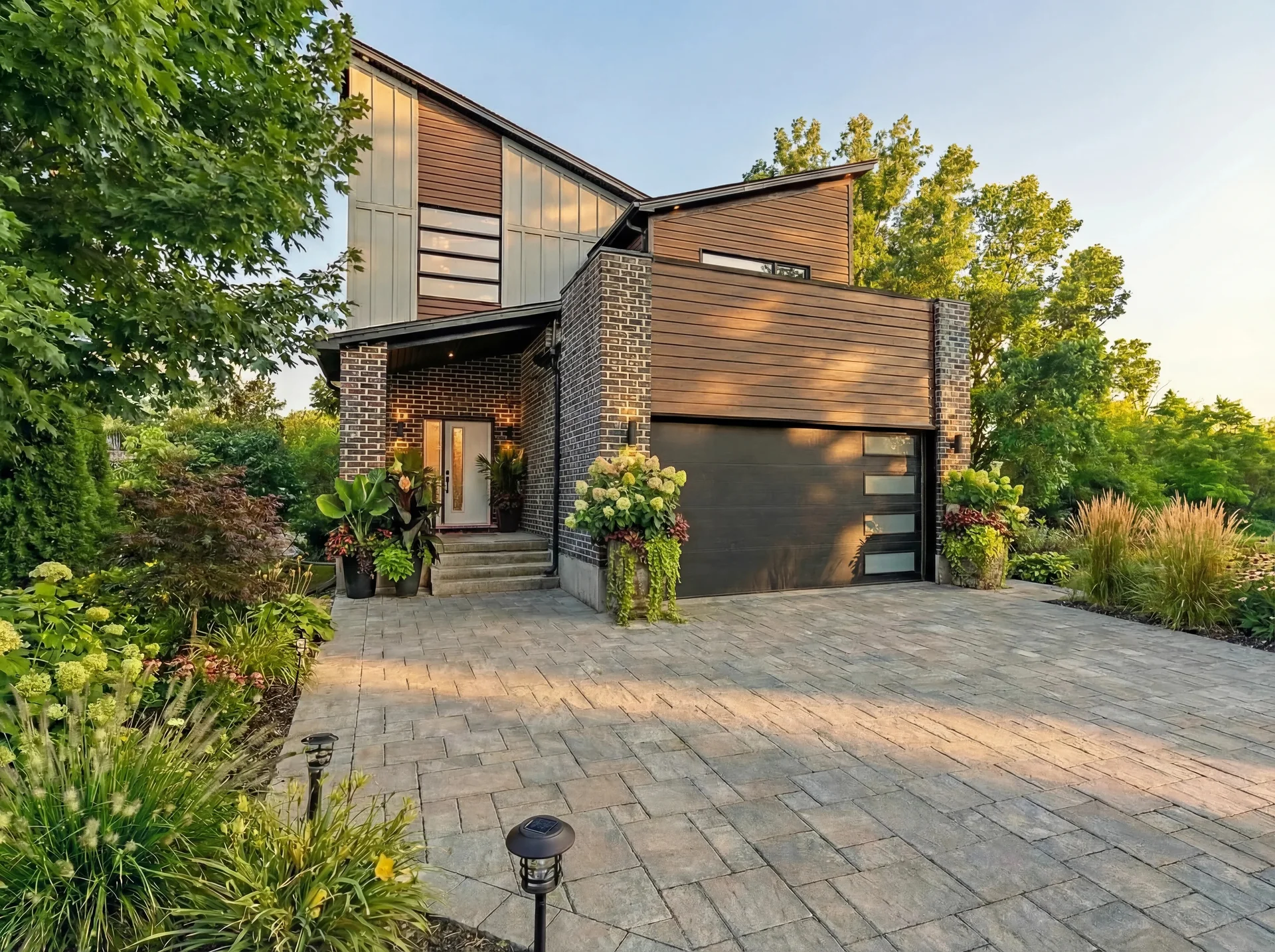
1.5
ACH50 — guaranteed on every home
0.85
ACH50 — Starlit portfolio average
3.5
ACH50 — typical Ontario code build
The Starlit ACH standard is simple: we guarantee 1.5 ACH50 or better on every home, and our portfolio average across 24+ builds is 0.85. ACH50 — air changes per hour at 50 Pascals of test pressure — is measured by a blower door test, and it's the single best predictor of a home's long-term energy costs, comfort consistency, and indoor air quality.
For context, a typical code-built home in Ontario tests around 3.5 ACH50. Our guarantee is more than twice as tight as that, and our portfolio average is roughly four times tighter. The guarantee is the floor we put in writing; the average is what our crews actually deliver. Here's why both numbers matter for your family, and how we hit them.
Airtightness isn't about sealing your home in plastic. It's about controlling air movement — deciding where, when, and how much fresh air enters, rather than leaving it to chance.
What ACH@50Pa Actually Measures
A blower door test installs a calibrated fan in an exterior doorway and depressurizes the building to 50 Pascals (roughly equivalent to a 32 km/h wind hitting every surface simultaneously). The fan measures how much air flows through the building envelope to maintain that pressure — expressed as cubic feet per minute (CFM50).
ACH@50Pa converts that airflow into a rate: how many times per hour the entire volume of the building's air is replaced through uncontrolled leakage at the test pressure. A result of 3.5 ACH@50Pa means the building's air volume leaks out 3.5 times every hour at 50Pa — a staggering amount of uncontrolled air exchange.
NRCan's EnerGuide rating system uses blower door results as a primary input for home energy modelling. Homes testing below 1.5 ACH50 consistently score in the top tier of the EnerGuide scale, and results in the 0.85 range — where our portfolio average sits — are approaching Net Zero performance territory. The same standard is covered in depth in our 2026 Building Science Guide.
"Your builder should be able to tell you their average blower door test result. If they can't — or if they don't test — that tells you everything you need to know about their commitment to performance."
Why Airtightness Matters: Energy, Comfort, and Health
The benefits of a sub-1.5 envelope compound across every dimension of home performance — and they keep compounding as the number drops toward our 0.85 average. They're also a big part of what you're paying for when you build to this standard; we break the dollars down in our guide to what it costs to build a custom home in Ontario.
Energy Savings
Air leakage accounts for 25–40% of heating and cooling loads in conventional homes. Dropping from a typical 3.5 ACH50 to our guaranteed 1.5 cuts that leakage-related waste by more than half; at our 0.85 portfolio average, roughly three-quarters of it is gone. In Ontario's climate, industry estimates put the annual savings in the four figures.
Comfort Consistency
Drafts are eliminated. Temperature differentials between rooms shrink from 3–5°C to less than 1°C. Cold spots near windows and exterior walls disappear because air isn't streaming through the envelope unchecked.
Noise Reduction
An airtight envelope is also a sound barrier. Homes tested below 1.5 ACH50 report 15–20 dB reductions in exterior noise transmission compared to code-minimum construction — transformative for homes near roads or urban environments.
Indoor Air Quality
Paradoxically, a tighter home has better air quality — because all fresh air enters through the ERV's MERV-13 filtration system, not through cracks that bypass filters entirely.
How We Get to 0.85: The Air Barrier System
A 0.85 portfolio average doesn't happen by accident. It requires a deliberate, continuous air barrier strategy that is designed before framing begins and verified through testing — the same discipline that makes the 1.5 guarantee a safe promise rather than a stretch goal. At Starlit, our primary air barrier is the ZIP System structural sheathing — a panel with a factory-applied water-resistive and air barrier coating, sealed at all joints with ZIP tape.
But the sheathing is only one piece. Every penetration — electrical boxes, plumbing stacks, HVAC boots, window and door frames — must be individually sealed with appropriate materials: fluid-applied membranes at window rough openings, acoustical sealant at partition-to-exterior intersections, and proprietary gaskets at service penetrations.
This air barrier approach works in concert with our thermal bridge elimination strategy — the same continuous insulation layer that breaks thermal bridges also protects the air barrier from mechanical damage and temperature cycling, extending its service life.
The Passive House Institute has demonstrated that buildings achieving 0.6 ACH50 (the Passive House airtightness target) maintain their airtightness for 25+ years with zero maintenance. Our portfolio average of 0.85 sits within reach of that benchmark — and well inside the proven durability threshold — which is part of why airtightness is the foundation of every Net Zero home we build.
"We perform mid-construction blower door tests — before drywall — so we can identify and fix any leakage paths while they're still accessible. The final test is a confirmation, not a discovery."
Airtight ≠ Sealed Shut: The Role of Mechanical Ventilation
The most common misconception about airtight homes is that they "can't breathe." In reality, an airtight home breathes better than a leaky one — because it breathes intentionally. Our ERV systems provide continuous, filtered, tempered fresh air at precisely controlled rates, regardless of wind speed, temperature, or season.
In a leaky home, ventilation is chaotic: too much on windy days, too little on calm days, and always through unfiltered pathways that admit pollen, dust, and soil gases. In a Starlit home, ventilation is consistent, efficient, and clean — every hour of every day.
Key Takeaways
ACH50 measures how many times your home's air volume leaks per hour at test pressure — lower is better.
A typical Ontario code build tests around 3.5 ACH50. We guarantee 1.5 or better on every home; our portfolio average is 0.85.
Airtightness eliminates drafts, cuts the majority of leakage-related energy waste, and reduces exterior noise by 15–20 dB.
Controlled mechanical ventilation (ERV) replaces chaotic air leakage with filtered, tempered fresh air.
Mid-construction blower door testing identifies leaks while they're still accessible for repair.
Ask your builder for their average blower door result — it's the single most revealing quality metric.