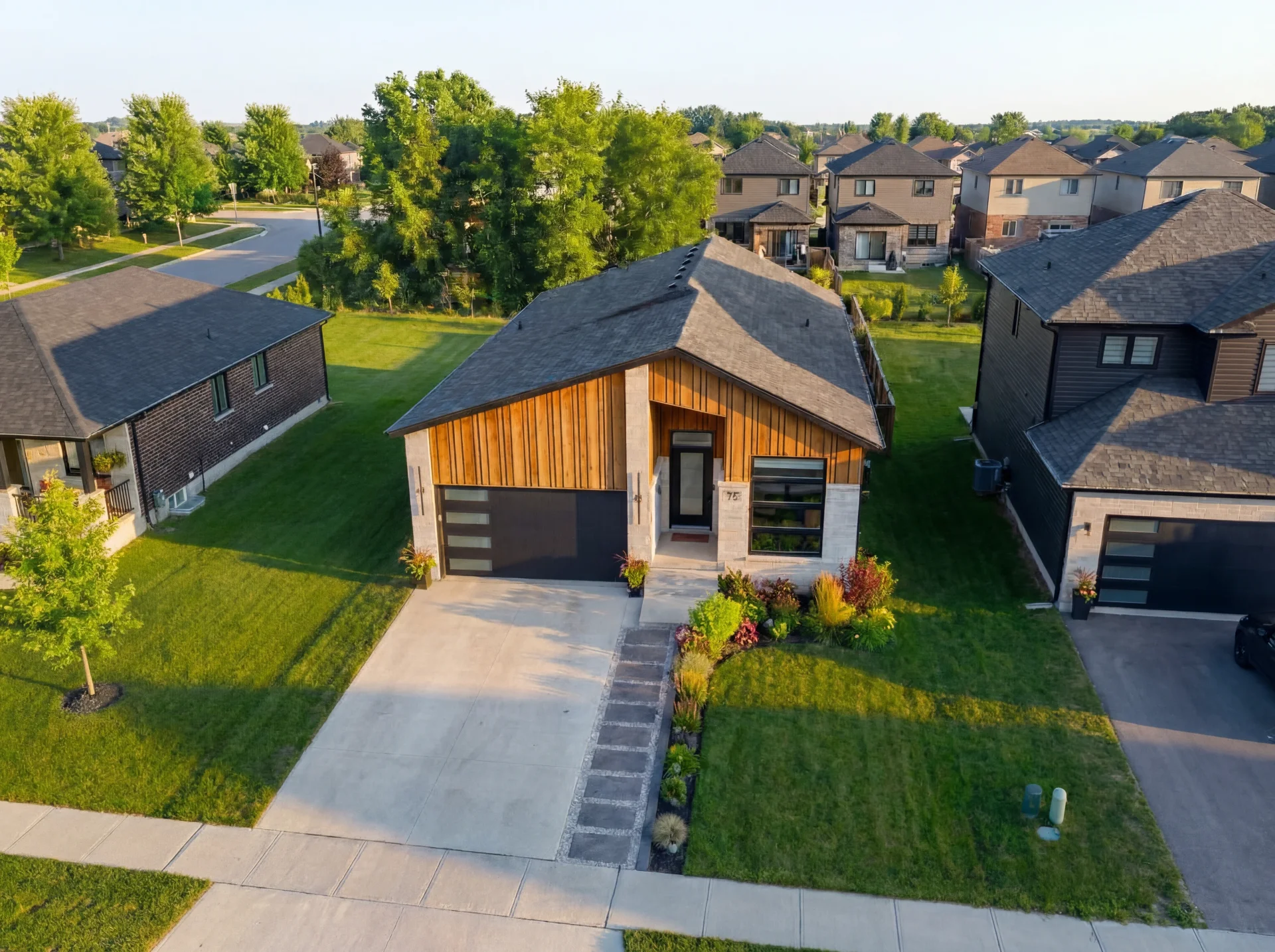
$300–450
Per sq ft — high-performance custom (market range)
$200–300
Per sq ft — production-style build (market range)
$500+
Per sq ft — ultra-luxury (market range)
In 2026, building a custom home in Southwestern Ontario typically costs somewhere between $300 and $450 per square foot for the build alone — and that's before you add land, servicing, and the soft costs that rarely make it into an opening conversation. A production-style build on an easy lot can land closer to $200–$300 per square foot; an ultra-luxury estate with imported finishes and a complicated site can clear $500. Those are typical market estimates for the London region, not a quote, and the spread between them is the whole story.
The reason "what does it cost to build a house" has such an unsatisfying answer is that two homes of identical square footage can differ by hundreds of thousands of dollars depending on where they sit, what's behind the drywall, and how complicated the design is. A 2,400 sq ft home at $250/sq ft is $600,000 to build; the same footprint at $400/sq ft is $960,000. Same number of bedrooms, very different houses.
This is a builder's breakdown of where the money actually goes — land and servicing as separate line items, the build itself split by what's driving it, and the soft costs people forget. Every range here is a conservative Southwestern Ontario market estimate that varies by site and spec, so treat them as a planning frame rather than a price tag.
Start With the Three Buckets, Not One Number
Most cost-per-square-foot quotes you'll see online quietly bundle things that should be priced separately. The cleanest way to budget a custom home is to split it into three buckets: the land, the servicing and site work needed to make that land buildable, and the build itself. On top of those sit the soft costs — permits, design, financing — which usually add another 10–20% to the build figure.
When a builder gives you a single per-square-foot number, ask which of those buckets it covers. At Starlit, the per-square-foot figure we quote is the build — the house — and we line-item land, servicing, and soft costs separately so nothing hides. That transparency is the point. The number that surprises people on their final invoice is almost never the build; it's a servicing cost or a soft cost that was never named.
| Bucket | Typical SW Ontario range (2026) | What it covers |
|---|---|---|
| Land | $150k–$600k+ | Lot purchase — wildly location-dependent |
| Servicing & site work | $30k–$150k+ | Driveway, well/septic or hookups, grading, excavation |
| The build | $200–$500+/sq ft | The house itself, foundation to finishes |
| Soft costs | 10–20% of build | Permits, design, engineering, financing, insurance |
Ranges above are typical market estimates for the London region in 2026 and vary substantially by specific site and specification. They are not a Starlit quote.
"The build per square foot is the number everyone asks about. The number that wrecks budgets is almost always land, servicing, or a soft cost that nobody put on paper early enough."
Land and Servicing: The Bucket People Underestimate
Land is the most variable line in the entire budget. A serviced lot in an established London neighbourhood prices differently than an acre of raw ground outside Strathroy or Ilderton, and neither tells you what it'll take to build on it. Two lots at the same purchase price can carry tens of thousands of dollars of difference in site work before a single wall goes up.
Servicing is everything that turns a parcel into a buildable site. On a rural lot that often means a drilled well and a septic system, which together can run $30,000–$60,000 or more depending on soil and depth. In town you're connecting to municipal water and sewer instead, which carries its own permit and connection fees. Then there's the driveway, the grading, the excavation, and any rock or high water table the soil report turns up. None of that shows in a per-square-foot build number, which is exactly why we price it on its own.
Well & Septic (rural)
A drilled well plus a conventional or raised septic bed typically runs $30k–$60k+ in this region. Difficult soils, deep water tables, or an engineered system push it higher.
Municipal Hookups (in-town)
Connecting to water and sewer carries permit and connection fees that vary by municipality — usually lower than well/septic, but rarely trivial.
Excavation & Grading
Sloped lots, rock, fill, and drainage work all add cost. A flat, well-drained lot is the cheapest site you'll ever build on.
Driveway & Approach
A long rural driveway with proper base and culverts can cost more than a short urban one by an order of magnitude.
What Drives the Build Cost Up or Down
Once you're past land and servicing, five things move the per-square-foot number more than anything else. Understanding them is how you steer the budget instead of reacting to it.
1. Site & Foundation Complexity
A walkout basement on a slope, a high water table, or poor soil all add structural cost before the house even starts. A simple foundation on good ground is the cheapest place to start.
2. Envelope Specification
This is where high-performance building lives. Continuous exterior insulation, triple-glazed windows, and a guaranteed-airtight envelope cost more up front than code-minimum framing and double-pane glass — and they're most of what separates a $250/sq ft build from a $400 one.
3. Mechanical Systems
A hybrid heat pump plus gas furnace, an ERV with MERV-13 filtration, and active radon mitigation are more than a basic furnace-and-AC package. They're also where the operating-cost savings come from.
4. Finishes & Fixtures
The single most elastic line in the whole budget. Cabinetry, countertops, flooring, tile, plumbing fixtures, and millwork can double the interior cost depending on selections — and they're entirely within your control.
5. Design Complexity
Rooflines, ceiling heights, curves, cantilevers, and large spans all add labour and material. A clean rectangle is dramatically cheaper to build than an articulated custom shape — square footage being equal.
Of those five, two are mostly fixed by your lot and your family (site complexity and how big a house you need), and three are dials you control. Finishes are the easiest dial to turn. The envelope and mechanicals are where we'd push you not to cut, because those are the costs that pay you back — more on that below. Our custom home process walks every client through these trade-offs spec by spec before a number is ever committed.
The High-Performance Premium — and the Payback
Building to a real high-performance standard costs more than building to code. There's no honest way around that. Continuous insulation, better windows, a tighter envelope, and the mechanical systems that go with them add to the build figure — often a meaningful slice of the gap between the production range and the custom range above.
What that premium buys is a home that costs dramatically less to run. A code-built Ontario home leaks around 3.5 air changes per hour at test pressure; we guarantee 1.5 ACH50 or better and average 0.85 across our portfolio. Air leakage alone accounts for a quarter to forty percent of a conventional home's heating and cooling load, so cutting it by three-quarters takes a real bite out of the energy bill every month for the life of the house. Pair that with a heat pump running at three times the efficiency of a furnace and the operating savings compound year over year.
The honest framing is this: the premium is real, and so is the payback, and the payback runs on a timescale measured in years, not months. If you're going to own the home for a decade or more — most custom-home owners do — the math works in your favour, and you get a quieter, more comfortable, healthier house the entire time. A Net Zero home takes that logic to its conclusion: an envelope and mechanical package efficient enough that on-site solar can offset what little energy the house still buys.
"The cheapest house to build is rarely the cheapest house to own. The envelope premium is the part of the budget that quietly pays you back every January for thirty years."
Don't Forget the Soft Costs
Soft costs are the line items that aren't bricks and labour but are non-negotiable all the same. Architectural and structural design, engineering, the building permit and development charges, surveys and soil reports, construction financing interest, and builder's risk insurance all land here. As a rough planning figure, budget another 10–20% of the build cost for soft costs — more on a complex or heavily-engineered project.
Development charges in particular vary a lot by municipality and have climbed in recent years across Ontario, so they're worth confirming early with your specific local jurisdiction rather than assuming. These figures are typical market ranges, not a fixed schedule, and the only way to know yours is to price your specific lot and design.
How a Real Quote Comes Together
A per-square-foot figure is a planning tool, not a quote. The only way to get a real number is to price a specific design on a specific lot to a specific specification. That's how we work: spec first, number second. We define exactly what's behind the walls — the insulation, the windows, the air barrier, the mechanicals — and quote the home that's actually drawn, so there's nothing vague left to inflate the figure later.
If you want to understand the specifications before you talk price, our 2026 Building Science Guide lays out the standard we build to, and the FAQ answers the cost and process questions we hear most often. When you're ready for a figure on your own project, that's a conversation about your lot, your plan, and your finishes — not a number off a chart.
Key Takeaways
Custom builds in SW Ontario typically run $300–$450/sq ft in 2026; production-style ~$200–$300, ultra-luxury $500+ — all market estimates, not quotes.
Budget land, servicing/site work, the build, and soft costs as four separate buckets — bundling them hides the real number.
Land and servicing are the most underestimated costs; rural well-and-septic alone can run $30k–$60k+.
Five things move build cost most: site complexity, envelope spec, mechanicals, finishes, and design complexity.
The high-performance premium is real, and so is the payback — it shows up in every energy bill for decades.
A per-square-foot figure is a planning frame; only a spec-first quote on your specific lot and design is real.